
Exquisite Bitterness
By Kelsey Ronan

"The mystery of love is greater than the mystery of death." Oscar Wilde put those words into the mouth of Salomé, the girl who demands the head of John the Baptist be brought to her on a platter. The play, Salomé, was published in 1893. Thirty years later, another queer icon, Alla Nazimova, would bring those words to the screen in an extravagant box office bomb, masterpiece of camp, and a legend of queer cinema argued to be the first art film.
In the Gospels, King Herod marries Herodias. John the Baptist, preacher and prophet, pronounces it unlawful. At Herod’s birthday banquet, Herodias’ daughter, Salomé, dances to entertain his illustrious guests, and her stepfather is so pleased that he promises her anything she wants. At the urging of her mother, Salomé demands the head of the prophet John the Baptist on a platter. She then gives the head to her mother.
They say that love hath a bitter taste...
For centuries, the story inspired gory paintings by Caravaggio and Titian and poems that centered not Salomé, but her vengeful mother. Oscar Wilde, however, gave Salomé agency, a frenzied teenage libido, and a hint of necrophilia to scandalize the Victorians. Wilde’s Salomé is obsessed with the imprisoned Jokanaan (John the Baptist), who spurns her. Enraged, she has him beheaded. After she kisses Jokanaan’s severed head, she says to him, “There was a bitter taste on thy lips. Was it the taste of blood?... Nay; but perchance it was the taste of love.... They say that love hath a bitter taste...” Its production was banned in England, deemed “half Biblical, half pornographic.”
Few artists were better positioned to understand Wilde's fascination with outsiders and desire than Alla Nazimova. A stage actor trained in the tradition of Konstantin Stanislavsky; Nazimova became the highest paid actress of her time in 1917 after signing a 5-year contract with Metro Pictures (a predecessor of MGM) for $13,000 weekly. She forged her path as an arthouse auteur with Nazimova Productions. Her first works as a producer included literary adaptations of Alexander Dumas and Henrik Ibsen; Oscar Wilde was a natural next step.
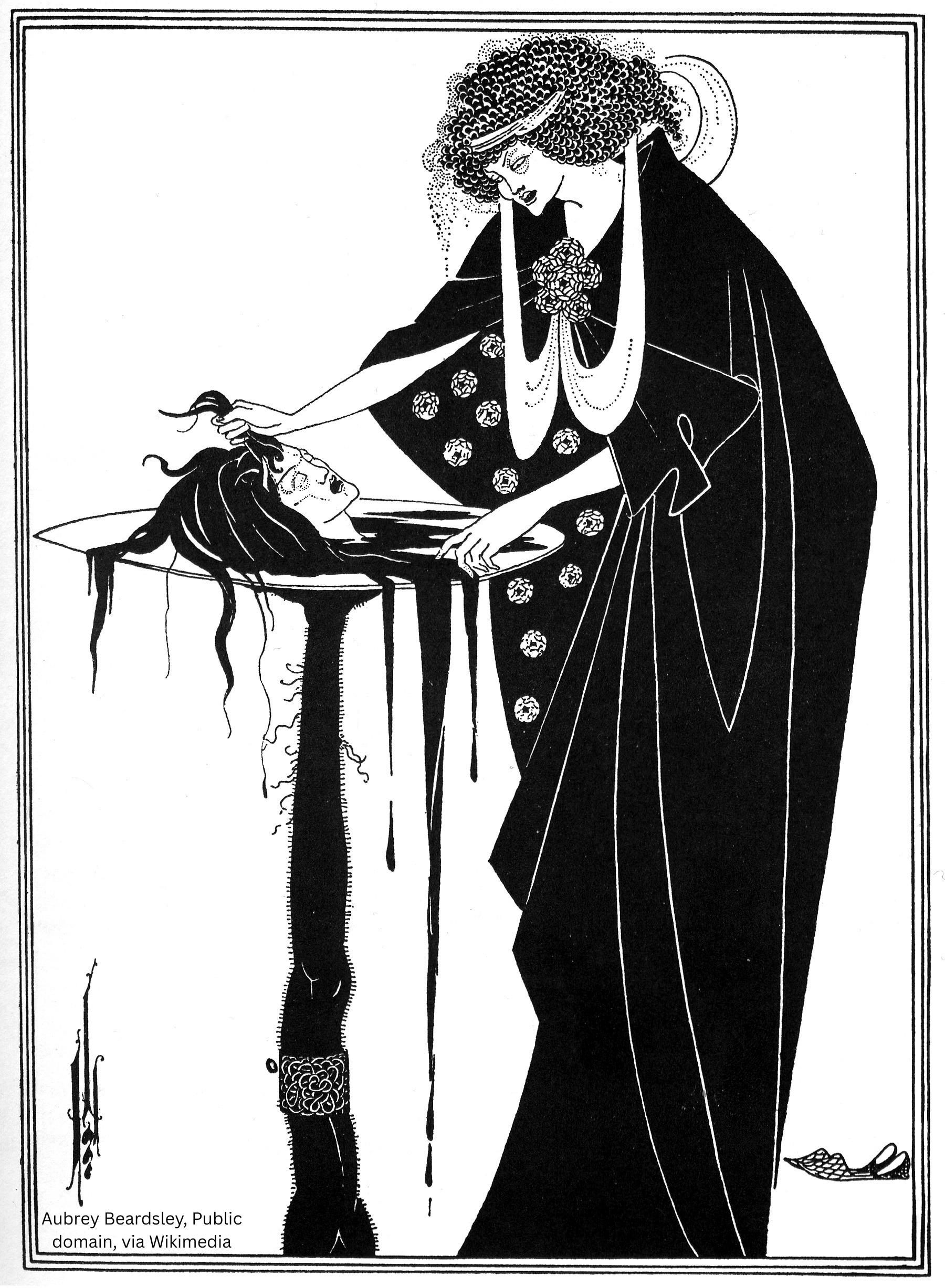
For Salomé, Nazimova found visual inspiration in Aubrey Beardsley black-and-white illustrations for Wilde's play– elongated figures, intricate arabesques– and in Sergei Diaghilev’s Ballet Russes and the work of Vaslav Nijinsky. On release, Nazimova requested the film be accompanied by an arrangement of themes from Debussy’s Prélude à l’après-midi d’un faune.
Even in black and white, the outfits glitter
The film was shot on an enclosed stage with a stark, blacked-out background that creates a black box theater effect. This minimalism contrasts the maximalist costumes by Natacha Rambova (the second Mrs. Rudolph Valentino, and rumored to be Nazimova’s lover), which seem designed for inhabitants of another planet. Even in black and white, the outfits glitter; in color, this movie might need a seizure-trigger warning. Characters wear skimpy costumes and towering, curiously shaped headpieces festooned with plumes, or bubble wigs that look like they’re pieced together with balls of yarn. Massive baubles adorn wrists and necks. Bare-chested men preen in fish scale-patterned tights and gladiator sandals. The film opens with Nazimova wearing what looks like a sequined track singlet and a tangle of Christmas lights on her head. For the infamous Dance of the Seven Veils, Rambova designed a strapless, mini-skirted sheath lined with rubber specially manufactured by an automobile tire company so that the fabric would cling closely to Nazimova's body.

That custom rubber-encased body belonged not to a fourteen-year-old princess but to a forty-two-year-old movie star. In a pre-Botox and filler world, before even the gauzy lenses of Dietrich and Garbo, Nazimova’s face with her dark lips and winged eyeliner is, in the parlance of our time, giving, but it’s not giving teenager. The camera often lingers on Nazimova’s face, emphasizing the drag-like audacity of her performance, or the delusion.
Nazimova is alleged to have financed the film’s estimated $400,000 budget and to have written the screenplay herself under a pseudonym. Salomé was inevitably sneered at as a pretentious fever dream and the vanity project of an aging screen siren. It flopped. Censors may have found it blasphemous, perverse, but most moviegoers found it simply inaccessible. As one Motion Picture News reviewer shrewdly pronounced, Salomé was “too ‘arty’ — too far over the heads of the everyday patrons, the majority of whom will wonder why it has been screened at all.” Nazimova Productions folded and Nazimova herself appeared in just a few more films in the 1920s. For decades, Salomé remained largely forgotten.
“Exotic and equally lesbian…”
Beginning in the mid-twentieth century, critics and historians started reassessing the film. What earlier viewers had dismissed as bizarre and incoherent was critically reevaluated as experimental. And after Salomé was screened at the New York International Festival of Lesbian and Gay films in 1989, the film gained status as a classic of queer cinema. Hollywood legend claimed that Salomé was produced by an "all homosexual cast." The claim is, of course, impossible to verify. But whatever the orientation of its cast, Nazimova’s sexuality is legendary. While her lavender marriage to The War Bride costar Charles Bryant lasted well over a decade, Nazimova is often credited with coining the term "sewing circles," referring to the network of queer women in Hollywood. Stories circulated about women-only pool parties at her lavish Sunset Boulevard estate, the Garden of Alla. She may or may not have had relationships with, among other women, both of Valentino’s wives, Anna May Wong, director Dorothy Arzner, and Oscar Wilde’s niece, Dolly. In Hollywood Babylon, Kenneth Anger refers to Nazimova as “exotic and equally lesbian… Hollywood’s most distinguished feminine import at the time.”
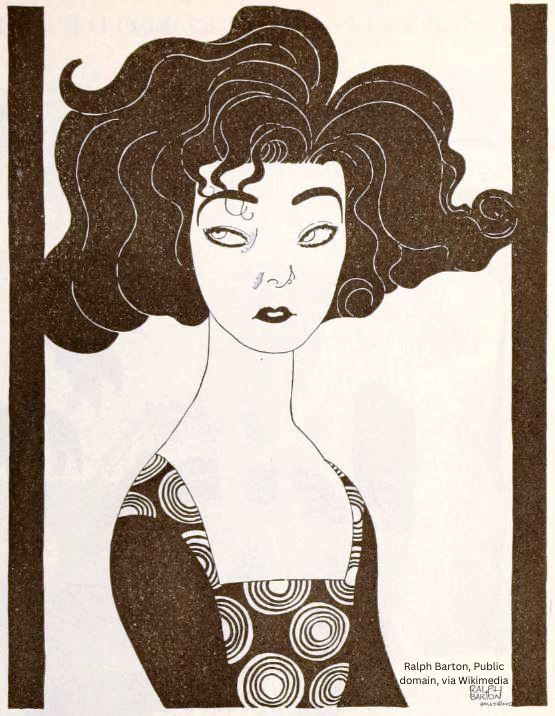
Portrait of Alla Nasimova by Ralph Barton (1921)
A dialogue between two queer artists ahead of their times.
Elements of Nazimova's visual world continue to echo through pop culture. Norman Jewison’s 1973 Jesus Christ Superstar seems to pay homage to Salomé in, appropriately, the Herod scene, as women in bikinis and bubble wigs dance the Charleston around the king. Lady Gaga's The Fame Monster era evokes some of the same hyper-stylized visual language as Nazimova’s platinum wig in the Dance of the Seven Veils.
Oscar Wilde wrote in The Picture of Dorian Gray, “Behind every exquisite thing that existed, there was something tragic.” Two years after Wilde published Salomé, he was found guilty of the crime of sodomy and served two years of hard labor. He spent his last years in exile in France. Nazimova, allegedly the inspiration for Norma Desmond in Sunset Boulevard (shown at the Senate on April 28, 2018) aged into obscurity and she died a tenant of the Garden of Alla, after it was converted into a hotel. Salomé occupies a fascinating place in cultural history– a dialogue between two queer artists ahead of their times. Wilde transformed a biblical princess into a symbol of bloody desire; Nazimova transformed Wilde's play into an avant-garde dreamscape unlike anything else Hollywood was producing. A century later, Salomé remains strange, excessive, and majestically queer.