
Strange Revolutionary: Cecil B. DeMille & The Volga Boatman
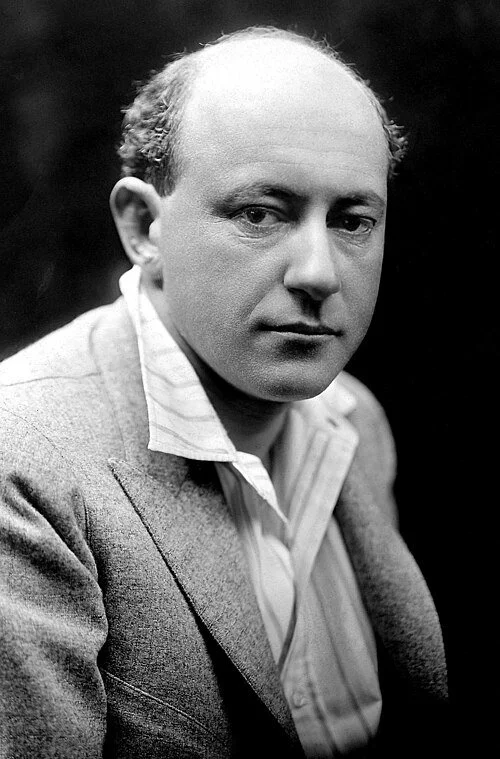
Cecil B. DeMille photographed by Albert Witzel ca 1920
By Kelsey Ronan
On a 1934 trip to America, Salvador Dali wrote to Andre Breton, “I’m in Hollywood where I’ve made contact with the three American Surrealists, Harpo Marx, Disney, and Cecil B. DeMille.” This seems to have been written in earnest.
Harpo was the silent Marx brother who contrasted slapstick comedy and razor-tongued wordplay with angelic harp solos. Walt Disney invented a talking mouse who captained a steamboat. These men are so familiar, their images so inextricably woven into movie history, that it’s easy to overlook how bizarre they must have been. It’s harder to see what Dali, famed painter of melting clocks and spider-legged elephants, found surreal about Cecil B. DeMille, a director of blockbusters and the archetype of Hollywood power: clad in jodhpurs and riding boots, perched on the edge of his chair, megaphone in hand, ready to eviscerate whoever was costing him money and time. In a career spanning from 1914 to 1958, his 70 movies weren’t arthouse fare of razorblades in eyeballs and expressionist shadows, but big budget romances, westerns, and Biblical epics, including Samson & Delilah, King of Kings, The Greatest Show on Earth, and The Ten Commandments (the most expensive and highest grossing film in Paramount’s history). In Sunset Boulevard, when poor Norma Desmond says, “All right, Mr. DeMille. I’m ready for my close-up,” she’s lost in a fantasy of ultimate red carpet stardom, of mass approval only a director of DeMille’s stature could bestow.

It’s inarguable, though, that DeMille was a pioneer.
Before DeMille was synonymous with Hollywood spectacle, Hollywood was just a barn in rural California. DeMille was the one who converted that barn into a studio.
In 1913, Cecil B. DeMille joined forces with Jesse Lasky and Sam Goldfish (later Goldwyn) to form the Jesse L. Lasky Feature Play Company. DeMille was its director general. Influenced by his early career in theater, DeMille’s first films were literary works made on a mission to turn the flicks into respectable middle class entertainment. His first feature film, The Squaw Man, was a Western based on a play of the same name by Edwin Milton Royle. DeMille rented a barn in then-rural Hollywood to convert into a studio. The Squaw Man, now credited as the first feature film made in Hollywood, was a success, raking in over ten times its budget. It was the first in a string of box office hits that made DeMille the most successful director in Hollywood. The Jesse L. Lasky Feature Play Company evolved into the Paramount Picture Corporation. The barn today houses the Hollywood Heritage Museum.
Over a decade into a prolific film career of Westerns, romances, and adventures, Cecil B. De Mille is said to have been inspired to make The Volga Boatman after seeing a painting at an art gallery. He may also have been inspired by the melancholy Russian folk ballad “The Song Of The Volga Boatmen,” popularized by Russian opera singer Feodor Chaliapin in the early 20th Century (Chaliapin’s baritone heave hos have spooky gravitas, but the Glenn Miller rendition is pretty fun). Whatever the case, DeMille was not inspired by any passion for revolution or socialist sympathies. The Volga Boatman opens with a pronouncement that it’s not here to talk politics. The title cards tell us, “Ours is not a story of a Crusade, or a Struggle, or a Victory. It pleads no cause– it takes no sides…To explain Revolution is no task of ours– Man cannot explain it.”
The movie’s hardly started, I know, but it’s worth pausing here. It’s unclear whether by Man DeMille is referring to his own limitations (or indifference) in explaining revolution or if he’s pandering to a popcorn-munching audience not looking for a social studies lesson. There’s a long history of revolutionaries extensively writing about why revolutions happen and why they ought to happen. Even within the scope of the Russian Revolution, Vladimir Lenin wrote much on the subject, including his 1917 polemic The State and Revolution, and was himself inspired by the writings of Karl Marx and Nikolay Chernyshevsky. American journalist John Reed’s Ten Days That Shook the World (1919) documented the Revolution firsthand. Even now, in this second MAGA administration’s historical revisions, we would be surprised to find the plaque outside Independence Hall reads that no one really understands what happened there and tbh, it’s none of our business, but please enjoy the Georgian architecture.
DeMille may have been attempting to have his cake and eat it too. Before the blacklist, the first red scare brought widespread paranoia of far-left political movements. The Palmer Raids saw the detainment and deportation of thousands of suspected communists, socialists, and anarchists; J. Edgar Hoover warned of May Day uprisings that never came. Europe, however, with its class conflicts and castles and radicals, made for box office gold. “Europeans dared what the innocent American flirts in a DeMille movie would never dare– to be direct and clear in their intentions, to express themselves emotionally, to seek fulfillment of their desires,” Robert Sklar explains in Movie-Made America.
The trick, then, was to depict revolution and hot-blooded revolutionaries while remaining unambiguously pro-American. Hollywood cranked out plenty of movies that attempted to do so: Benjamin Christensen’s Mockery (1927) starred Lon Chaney as a Siberian peasant protecting a countess from the Red Army. John Barrymore starred in Sam Taylor’s Tempest (1928), about a Red Army officer in love with a princess. One of the better received films of the era, Josef Von Sternberg’s The Last Command (1928) features Emil Jannings as a cousin of the Czar and White Army commander exiled, impoverished, and trying to make a living as a Hollywood extra.
But to return to The Volga Boatman:
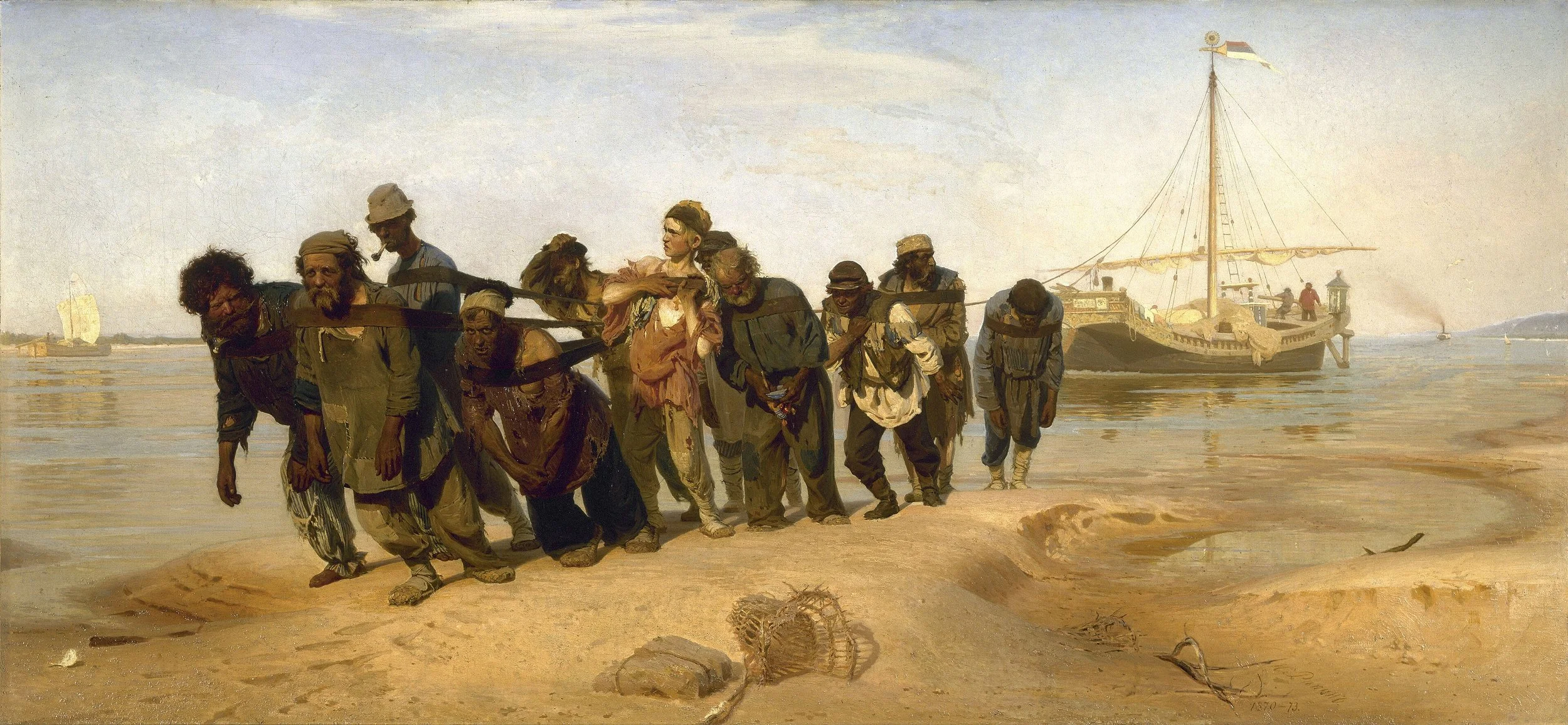
Ilya Yefimovich Repin's painting Barge Haulers on the Volga, 1873
The film opens at the foot of a castle. Boatmen, “the human mules of Russia,” are yoked together, hauling a barge up the Volga River. The camera lingers on their weary footfalls. They sing together to distract from the strain. One voice, that of Feodor (William Boyd before he became Hopalong Cassidy), rises above the rest. On an approaching carriage, Princess Vera (Elinor Fair) exclaims to her fiancé Prince Orloff (Victor Varconi), “That voice seems the very soul of Russia!” Feodor is next seen rejecting the advances of a sexy fortune-teller (Julia Faye). “There is no room in my life for a woman!” Feodor proclaims. “I belong to Russia and the day of freedom!”
This is the meet-cute, or the moment the star-crossed tragedy begins: the princess in love with the hot guy on the wrong side of the battle lines, the rich asshole who won’t let her go. She’s got buttons climbing up her delicate throat and fur wound around her head; he’s got dirt-smudged cheeks and appears to be wearing wicker baskets for shoes. Prince Orloff is called up to serve the White Army. The Red Army storms Princess Vera’s castle and Feodor has to choose between his convictions and a delicate, recalcitrant woman in an evening gown. So much for belonging to Russia.
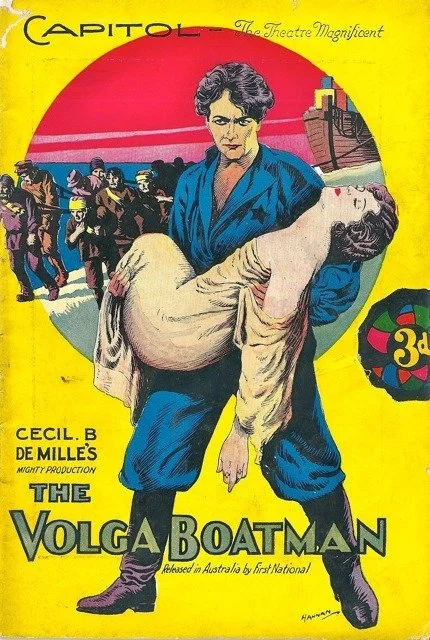
The Volga Boatman premiered in New York City on April 13, 1926, accompanied by a full orchestra and choir.
A Russian balalaika orchestra entertained during the intermission.
The film was a commercial success, though reviews were mixed. In a delightfully smug review from that century-old source of smug reviews, The New Yorker , Theodore Shane wrote,
A silly and incredibly cheap story of the Red Revolt in Russia, it is the worst studio weed yet to flower from the hokum-ridden (shrewd) mind of Mr. Cecil B. De Mille in all his glutinous career. All that concerns him in Russia is the Grand American Thesis, that Love (ah, the beautiful Grand Passion!) transcends everything—even Russian shambles and Human Stockyards. An offense to Russia and to the intelligence.
I’ll concede that The Volga Boatman isn’t saying anything profound about class struggle, but it’s great fun to watch. William Boyd and Elinor Fair are beautiful and it’s fun to watch them flirt with each other. They did such a good job pretending to be in love with each other that they convinced themselves– Fair became the third Mrs. Boyd during production. The visuals are compelling, from the masses of extras and horses to the palatial interiors. I watched a copy on YouTube with a score patched together from Stravinsky’s Rite of Spring and The Firebird and I couldn’t let myself finish it, excited at the prospect of watching it on the big screen.
And it’s true that I, a bus driver’s kid from Flint and a card-carrying union member (Michigan Education Association), kept thinking about the Volga boatmen hauling the barge, straining against the harness, the camera lingering on the heavy falls of their ill-shod feet. The Volga Boatman’s contrasting images of physical labor and leisure, obliviousness and righteous fury, hunger and abundance have an emotional power that DeMille's apolitical disclaimer can't dismiss entirely. As the angry mob surrounds the castle, the terrified Princess warns her father. In formal dress, he says, “My dear, dinner is served” with, to reference another Revolution, a “let them eat cake” sort of obliviousness. A servant lights his cigar. Once inside, the mob doesn’t torch the place, but demands to be fed by the people they’ve been serving. The movie doesn’t trouble itself with explaining the Romanov dynasty and the feudal system, but there’s a sympathy for the working class– or at least a sentimentality about the working class– lurking under the surface.
In 1947, critic James Agee called Cecil B. DeMille “an artist in ham,” his name “loosely used as shorthand for fustian and splendiferous vulgarity.” But Agee also called DeMille a “pioneer” whose “artistry has sometimes not been widely enough appreciated.” He explained,
When Cecil B. DeMille went to California in 1913 and rented half a barn in which to film The Squaw Man, there was a village there called Hollywood. But none of the innocents who lived in the village dreamed, in their wildest nightmares, how radically Mr. DeMille and his followers would alter their community.
Salvador Dali, that visionary painter of nightmares, who called movies "mysterious strips of hallucinatory celluloid,” may have seen something in DeMille that critics didn’t. Maybe the surreal thing about DeMille was that he could take any fraught moment in history, any Old Testament scripture, and smooth it into a Hollywood blockbuster, complete with a bare-chested matinee idol.
Dali later gifted Harpo Marx a barbed wire harp (Harpo responded with a photo of his hands in bandages) and wrote a screenplay for the Marx Brothers called Giraffes on Horseback Salad (Groucho turned it down). Dali and Walt Disney collaborated on an animation called Destino that never saw the light of day. Salvador Dali was said to have thrown himself at DeMille’s feet when they met. How DeMille responded doesn’t seem to have been recorded.